top of page


Sectional Studies: Negotiating the River Wall
In landscape architecture, the "edge" is rarely a thin line; it is a complex zone of transition. These three images focus on the vertical and horizontal surfaces where the Thames meets the city. I am interested in how these surfaces act as a canvas for ecological succession and a repository for river-washed materials. The Intertidal Accumulation Looking down at the base of the river wall. The receding tide leaves behind a "tideline" of sorted materials—rubble, silt, and organ


Hard Edges, Soft Flux: The Architecture of Coexistence
The Colossus in the Reach. The Thames Barrier is often viewed purely as a machine for flood defense. But in 'Tracing Ecologies,' I am viewing it as a permanent geographic feature. Its piers create localized eddies and change the sedimentation patterns of the riverbed, inadvertently becoming a key structural element in the river’s hydrological behavior. Spontaneous Colonization. While the Barrier is made of steel and concrete, the river responds with biology. Here, I’m documen


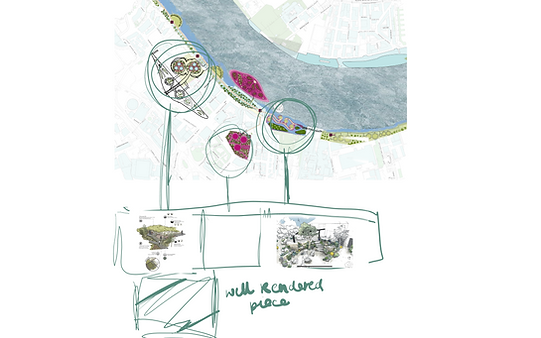
Mapping the Invisible: Translating Observation into Design
Tracing the Waders. I’m mapping the specific foraging patterns of the Dunlin and Redshank. Their movement is dictated by the tide—a choreography of survival. My design work must respond to these temporal ebbs and flows. Ecological Anchors. A simple rock isn't just a weight; it's a substrate for moss, which in turn supports a microcosm of invertebrates. I am exploring how 'hard infrastructure' (like the barrier or the river wall) can be softened to encourage these micro-ecolog
No Collections Here
Sort your projects into collections. Click on "Manage Collections" to get started


bottom of page